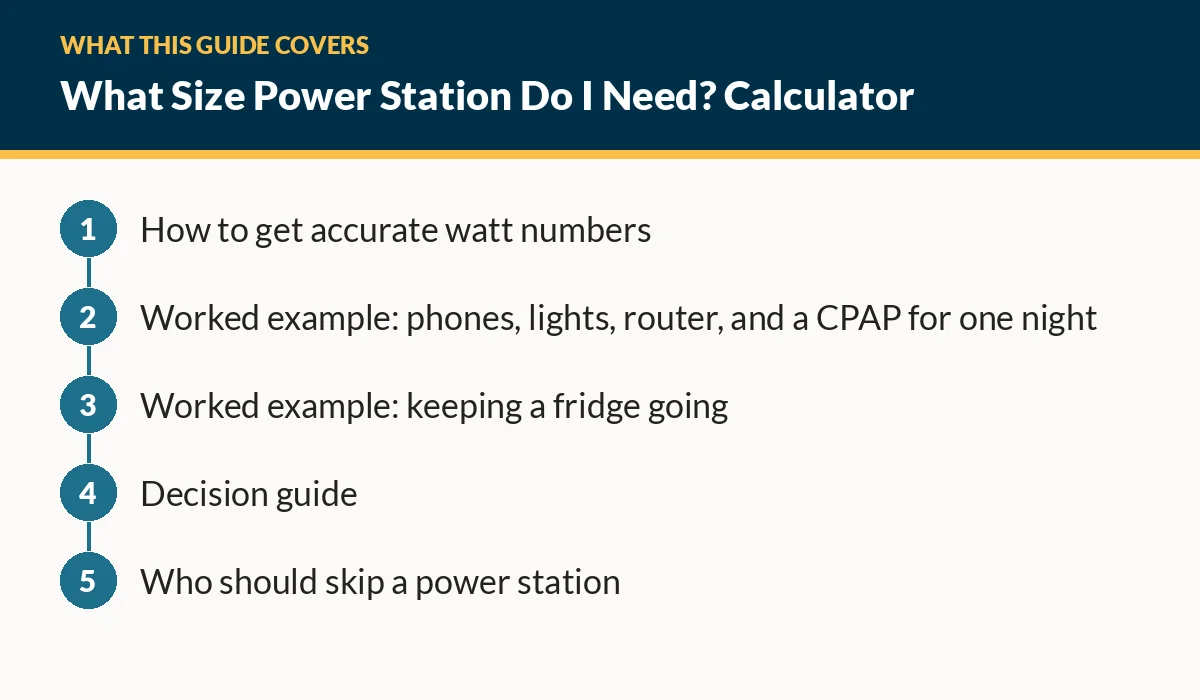
What Size Power Station Do I Need? Calculator
Disclosure: This page contains affiliate links. If you buy through them we may earn a commission at no extra cost to you. As an Amazon Associate I earn from qualifying purchases. Details.
Power station marketing leads with big numbers. Two numbers actually matter:
- Capacity (watt-hours, Wh): how much energy is stored. This decides how long things run.
- Output (watts, W): how much it can deliver at once. This decides what you can plug in. Motors (fridges, pumps) also need a short surge rating above their running watts.
The calculator below adds up your devices and tells you what to look for. It runs entirely in your browser.
How to get accurate watt numbers
The defaults above are typical round numbers, not your device. Better sources, in order:
- The device label or power brick. Look for "W" or multiply volts by amps (V × A = W).
- The manual or the manufacturer's spec page. CPAP makers, for example, publish power use with and without the humidifier, and the difference is large.
- The EnergyGuide label on refrigerators and freezers shows estimated kWh per year. Divide by 365 for kWh per day, then multiply by 1,000 for Wh. ENERGY STAR explains how fridge efficiency varies by size and style.
- A plug-in watt meter measures the real draw over a day. It is the most accurate method for a fridge, whose compressor cycles on and off.
Worked example: phones, lights, router, and a CPAP for one night
| Device | Watts | Hours | Wh |
|---|---|---|---|
| 2 phones | 10 each | 2 | 40 |
| LED lantern | 5 | 10 | 50 |
| Wi-Fi router | 8 | 4 | 32 |
| CPAP, humidifier off | ~45 (model-specific) | 8 | 360 |
| Total | 482 |
Add a 25% margin and you get about 600 Wh. That is a mid-size station, not a huge one. Turn the CPAP humidifier on and the number can roughly double, which is exactly why you should check your own model's figures.
Worked example: keeping a fridge going
Say your fridge's EnergyGuide label shows 600 kWh per year. That is about 1.6 kWh (1,600 Wh) per day. With a 25% margin, a full day needs about 2,000 Wh. But you probably do not need a full day: USDA says an unopened fridge holds safe temperatures for about 4 hours. Running it for an hour or two every few hours can stretch a smaller station a long way.
Decision guide
- Under 300 Wh needed: a quality power bank or two may be enough. Skip the power station.
- 300 to 1,000 Wh: a mid-size station covers phones, lights, router, and a CPAP for a night.
- 1,000 to 3,000 Wh: fridge support for a day plus essentials. Check surge rating and weight (these get heavy).
- Over 3,000 Wh, or you need heat: look at expandable battery systems, a properly installed generator with a transfer switch, or simply fewer devices. Batteries are a poor way to make heat.
See power stations by household size for what to look for in each class.
Who should skip a power station
- If your number is under about 300 Wh, power banks cost far less and do the job.
- If you mainly want heat, a battery will disappoint you. Focus on insulating one warm room.
- If outages in your area routinely last several days, a battery alone will run out. You would need solar recharging or a safely installed generator.
FAQ
What size power station do I need to run a refrigerator?
Check the fridge's yellow EnergyGuide label for kWh per year and divide by 365 to get daily use. Many full-size fridges use roughly 1 to 2 kWh per day, so keeping one running for a full day typically needs a station well above 1,000 Wh, plus an inverter that can handle the compressor's startup surge.
Why does the calculator add extra capacity?
Power stations lose some energy converting battery power to household AC, and you should not plan to drain a battery to zero. We add a margin (adjustable) so the number you shop for is realistic.
Can a power station run a space heater?
Technically a large one can for a short time, but a 1,500-watt heater would drain even a 2,000 Wh station in roughly an hour. Heated blankets and warm clothing are far better uses of battery power.
Related guides
- Portable Power Stations by Household Size (What to Look For)
- Winter Power Outage Checklist (Printable)
- How to Stay Warm When the Power Goes Out in Winter (Safely)